
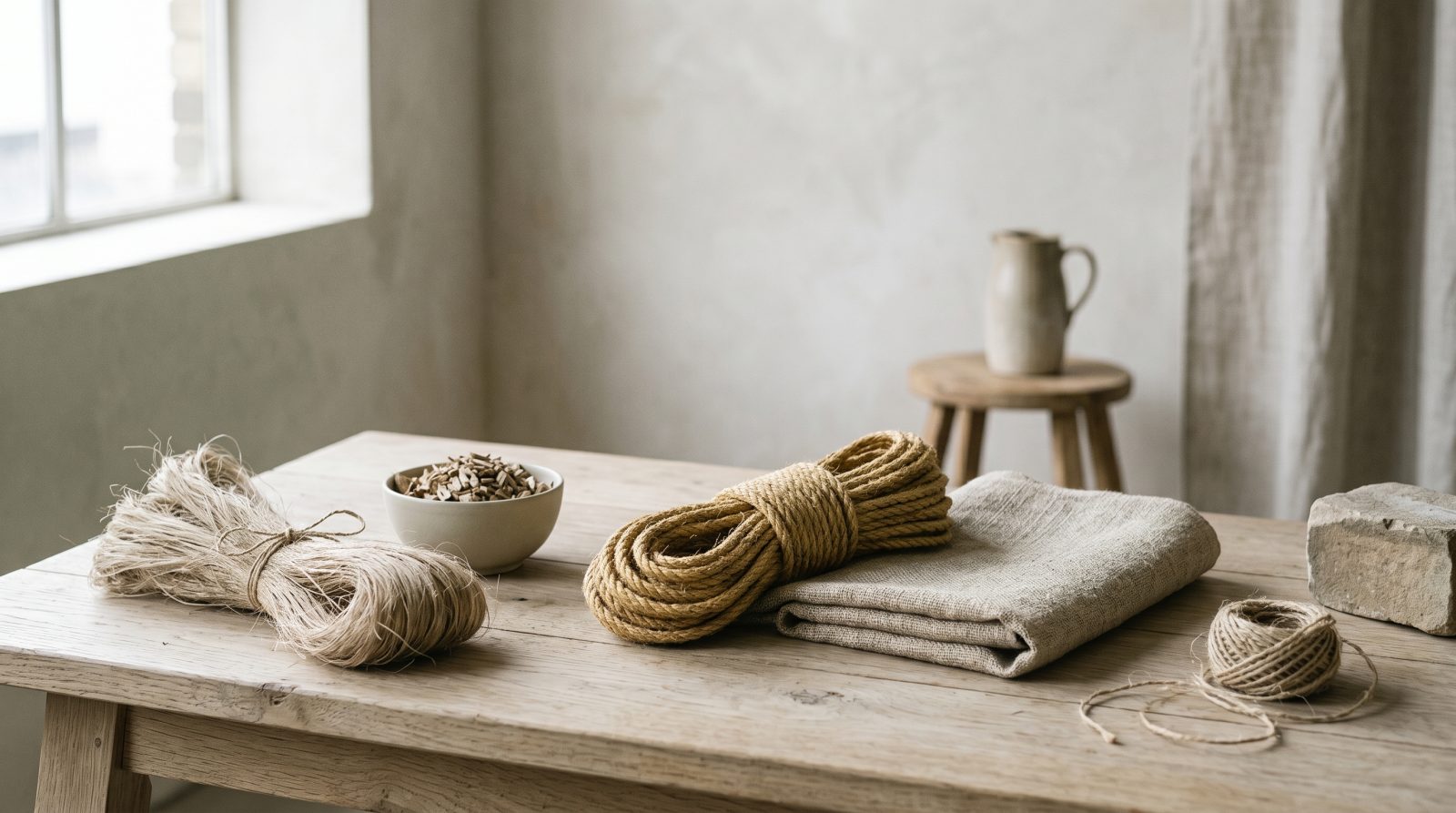
Industrial hemp fibre is processed into two distinct material categories: bast fibre (the long fibres from the outer stalk) and hurd (the woody inner core). These two materials serve different end markets. Bast fibre becomes textiles, paper, rope, and composite reinforcements. Hurd becomes building materials, animal bedding, mulch, and biocomposites.
The hemp stalk structure
A mature hemp stalk consists of:
- Bast fibre (outer layer). Long, strong fibres typically 1-3 meters in length, with cellulose content around 70-75 percent. The high tensile strength and long fibre length make bast suitable for spinning into yarn or weaving into fabric.
- Hurd (woody core). The lignified inner core that forms the bulk of the stalk by weight. Highly absorbent, low density, with cellulose content around 40-50 percent. The short, woody nature makes hurd suitable for moulding, mixing with binders, or pellet production.
- Pith and other materials. A small fraction of the stalk; typically processed as a waste stream or incorporated into hurd products.
Bast fibre vs hurd by weight
| Component | Weight share | Primary applications |
|---|---|---|
| Bast fibre | 20-30% | Textiles, paper, rope, fibreglass alternatives |
| Hurd | 55-65% | Hempcrete, animal bedding, mulch, biocomposites |
| Other/loss | 5-15% | Process waste, fines |
The processing chain
Hemp fibre processing involves several steps:
- Cultivation of fibre-specific hemp cultivars (taller, longer-stem varieties optimized for stalk length over seed yield)
- Harvesting at the right maturity (after flowering but before seed maturity for highest bast quality)
- Retting, controlled biological breakdown of stem material to loosen the bast fibres from the hurd
- Decortication, mechanical separation of bast from hurd
- Refinement, further processing of bast or hurd to product-ready material
- Manufacturing, final product production by downstream manufacturers
The Canadian hemp fibre industry
Hemp fibre production in Canada lags hemp grain production significantly. The fibre industry's primary constraint is decortication capacity; without sufficient processing facilities to separate bast from hurd, raw hemp stalks cannot become saleable fibre. Several projects are addressing this constraint in the Prairie provinces, but commercial-scale fibre processing remains limited compared to the potential.
Most Canadian-grown hemp is grain hemp; the fibre side is often exported as raw or minimally processed material for finishing in Europe or Asia, where established decortication infrastructure exists.
Hemp fibre versus other natural fibres
| Fibre | Tensile strength | Fibre length | Cultivation requirements |
|---|---|---|---|
| Hemp bast | Very high (550-900 MPa) | 1-3 m | Low water, low pesticide |
| Cotton | Moderate (300-700 MPa) | 2-5 cm | High water, often high pesticide |
| Flax (linen) | Very high (500-900 MPa) | 30-90 cm | Moderate water |
| Jute | Moderate (250-400 MPa) | 1-4 m | High water; tropical |
| Bamboo (mechanical) | High (500-800 MPa) | Variable | Renewable, low input |