
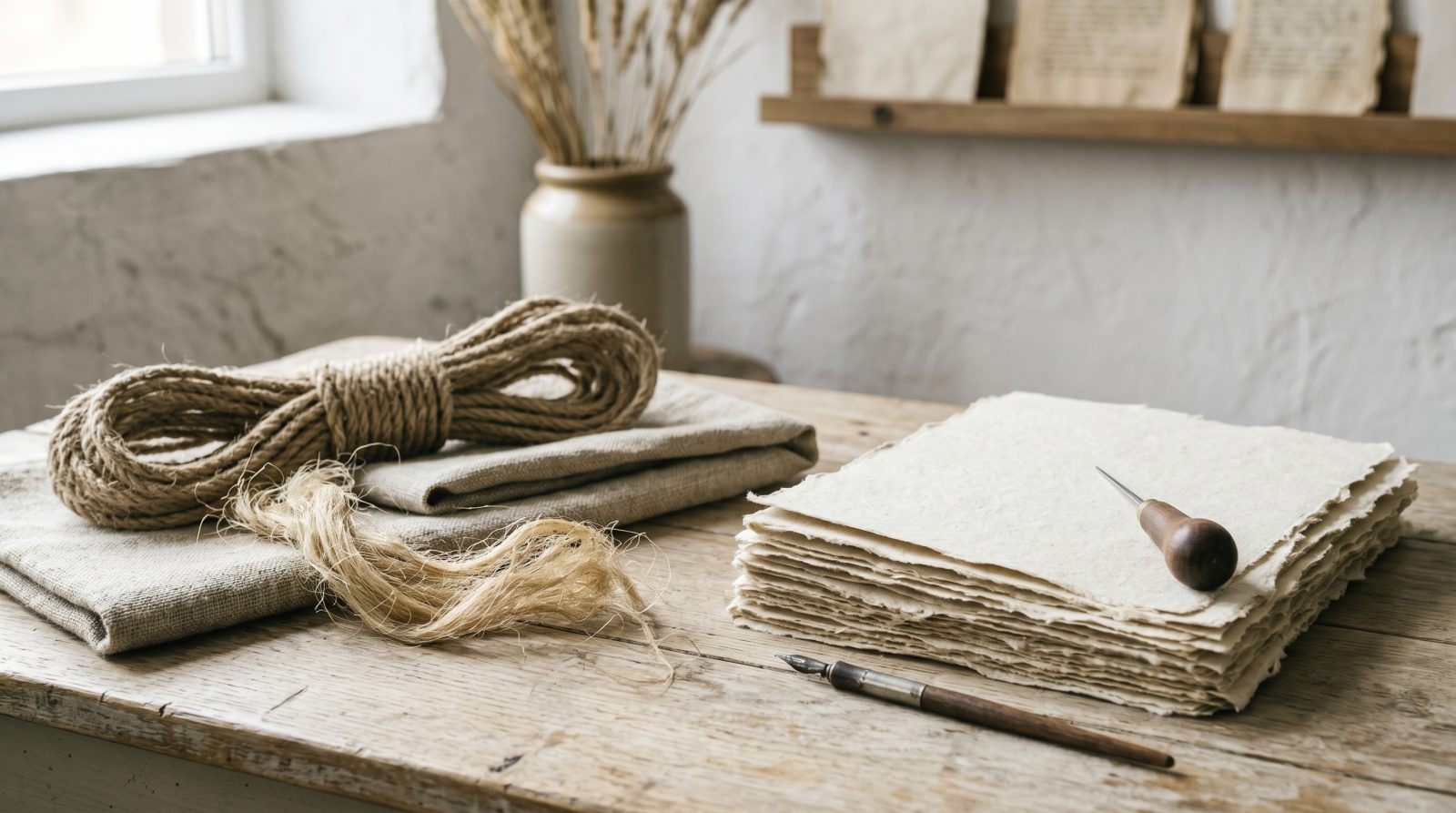
Hemp paper was the dominant paper format in much of the world until the early 20th century, when wood pulp processing scaled up. Today hemp paper is a small but growing specialty category. The fibre's length and strength produce paper that outperforms wood-pulp paper on durability and longevity, though wood pulp remains dominant on cost.
How hemp paper is made
The production process broadly mirrors wood pulp paper but uses hemp bast fibre as the source:
- Bast separation from the harvested hemp stalk (decortication)
- Pulping through chemical or mechanical processes
- Bleaching (optional, depending on desired colour)
- Sheet formation on traditional paper-making screens or modern Fourdrinier machines
- Pressing and drying to remove water and consolidate fibres
- Finishing with surface treatments, calendering, or coatings as required
Properties of hemp paper
- Longevity: Hemp paper can last for centuries without significant degradation, compared to acid-treated wood pulp paper which yellows and becomes brittle within decades.
- Tear resistance: Longer fibres produce stronger paper that resists tearing.
- Foldability: Hemp paper can withstand repeated folding without breaking, important for archival documents and certain printing applications.
- Whiteness: Naturally lighter than wood pulp, requiring less bleaching.
- Translucency: Can be made very thin while remaining strong.
Where hemp paper is used today
- Cigarette papers (rolling papers): hemp's thin, flavour-neutral character is well-suited
- Archival documents where centuries of stability matter
- Banknote papers in some countries (combining hemp with cotton)
- Specialty stationery for premium positioning
- Bible paper (very thin printing paper) where thinness with strength is needed
- Tea bags where natural-fibre tea bag papers are required
- Artistic papers for printmaking, watercolour, calligraphy
Hemp paper vs wood pulp paper
| Attribute | Hemp paper | Wood pulp paper |
|---|---|---|
| Fibre length | Long (10-50mm) | Short (1-3mm) |
| Strength | Higher | Lower |
| Longevity | Centuries | Decades |
| Cost per sheet | Higher | Lower |
| Production scale | Small | Massive |
| Yield per acre | Higher (annual crop) | Lower (slow tree growth) |
| Renewable cycle | 3-4 months | 20-100+ years (forest) |
| Bleaching required | Less | More |
| Common availability | Specialty only | Universal |
The historical context
Hemp paper has a long history of use. Most paper documents from medieval Europe through the early industrial era were made from hemp and other plant fibres (cotton, linen, and various rags). The shift to wood pulp paper in the mid-19th century was driven by:
- Need for cheaper paper to support mass-produced newspapers and books
- Industrial sulphite and kraft pulping processes that worked with wood
- Abundance of forest resources in North America and Northern Europe
- Decline of textile rag waste that had previously supplied paper makers
By the 1880s, wood pulp had displaced most other fibres in mass paper production. Hemp paper became a specialty product.
The contemporary revival
Several factors are driving renewed interest in hemp paper:
- Demand for sustainably-sourced paper products
- Concerns about forest sustainability and deforestation
- Growing capacity in industrial hemp processing
- Premium positioning opportunities in stationery, art papers, and specialty applications
- Carbon footprint considerations
The Canadian hemp paper industry
Canadian hemp paper production is essentially non-existent at industrial scale. Specialty paper makers occasionally produce hemp papers for art and craft markets. The infrastructure for industrial-scale hemp pulping does not exist in Canada. Most "hemp paper" sold in Canada is imported from Europe, China, or specialty US makers.
For commercial-scale hemp paper to emerge in Canada, hemp fibre processing capacity would need to grow substantially first. Pulping mills are expensive to construct ($100+ million for industrial-scale facilities), and the economics depend on consistent, large-volume fibre supply that does not yet exist domestically.
Sustainability considerations
Hemp paper is often promoted as more sustainable than wood-pulp paper. The relative sustainability depends on several factors:
- Hemp's high yield per acre means more paper from less land
- Annual harvest cycle vs decades-long tree growth
- Less water and energy in pulping (typically)
- Less bleaching required due to lighter natural colour
- Soil regenerating properties of hemp cultivation
However, well-managed sustainable forestry can also produce paper sustainably, and the relative ranking depends on specific operations and lifecycle analyses.