
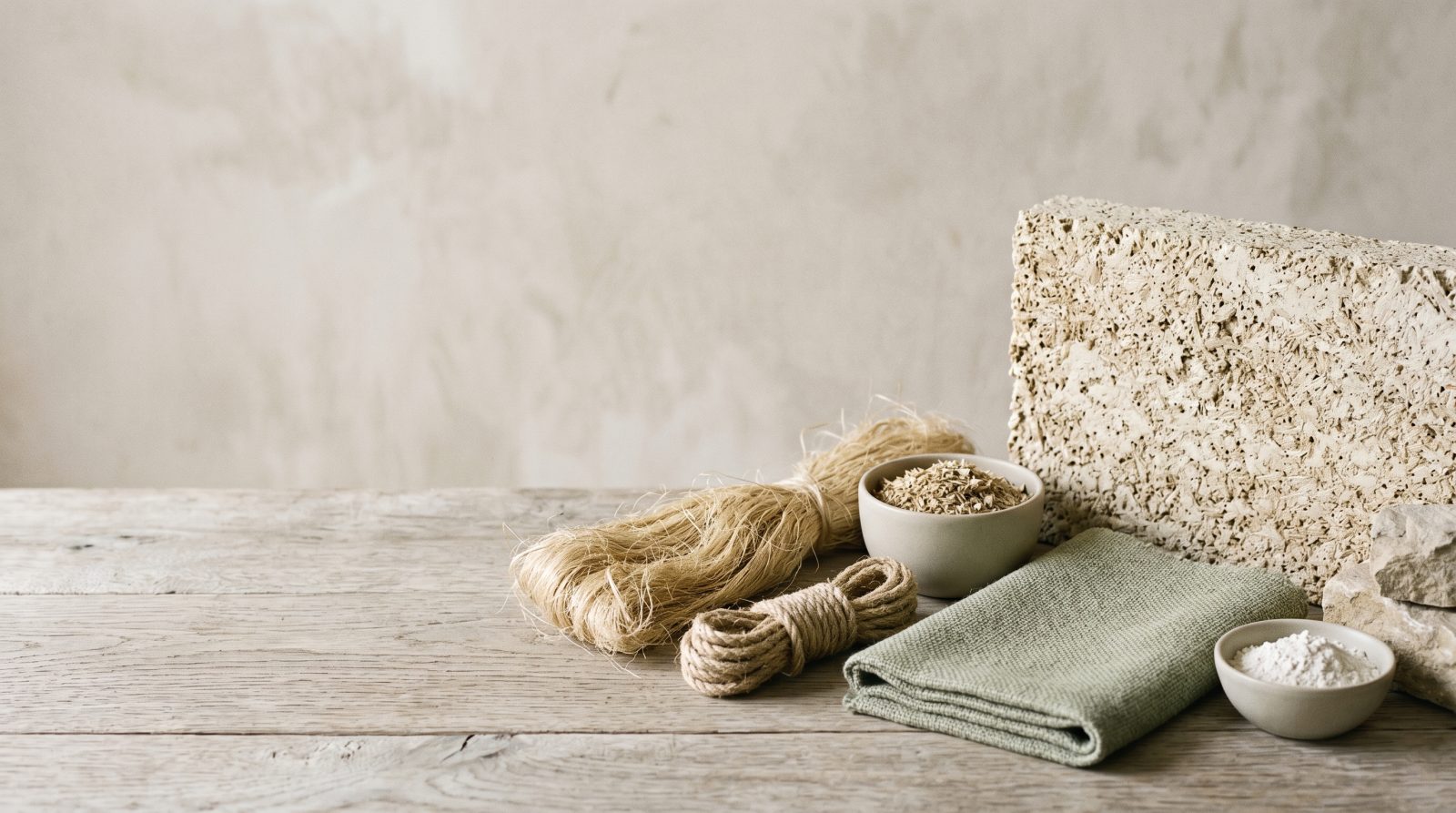
Hempcrete is a bio-composite building material made from hemp hurd, lime-based binder, and water. It is used as wall infill, insulation, and finishing material in low-rise construction. The material is breathable, lightweight, and stores carbon over its long service life. Hempcrete is not load-bearing; it requires a structural frame.
What hempcrete is
Hempcrete is composed of:
- Hemp hurd (also called hempsh chiv): the woody inner core of hemp stalks, typically 60-70 percent of the mix by volume
- Lime-based binder: either hydraulic lime, pozzolanic lime, or hydrated lime with pozzolanic additives, typically 20-30 percent
- Water: needed for binder hydration, typically 10-15 percent
The mixture is wet-mixed and cast in place around a structural frame, or pre-cast into blocks for installation. Curing takes several weeks to months, during which the lime carbonates and binds the hurd into a solid mass.
Hempcrete properties
- Density: 300-600 kg/m³ (lighter than concrete; comparable to insulation board)
- R-value: R-2 to R-2.5 per inch thickness (similar to fibreglass batt; lower than rigid foam)
- Compressive strength: 1-3 MPa (much lower than concrete; not load-bearing)
- Hygroscopic: Absorbs and releases moisture, regulating indoor humidity
- Fire resistant: 1-2 hour fire rating depending on thickness; rated for structural fire applications when combined with structural frame
- Sound absorbing: Provides meaningful acoustic insulation
- Biodegradable: Can be composted at end of building life
Hempcrete applications
- Wall infill in timber, steel, or concrete-framed buildings
- Insulation in retrofit applications
- Roof insulation (with structural support)
- Floor screeds for thermal and acoustic insulation
- Renovation of older buildings, particularly in stone construction
- New construction of low-rise residential, commercial, and institutional buildings
What hempcrete is not
- Load-bearing. It cannot support the weight of a building; structural framing is required.
- Suitable for foundation work. Below-grade applications generally not appropriate.
- Equivalent to concrete. The materials have different properties and applications.
- Faster than conventional construction. Curing takes weeks to months.
Cost considerations
Hempcrete construction in Canada typically costs more per square foot than conventional construction due to:
- Higher material cost (hemp hurd and lime binder)
- Limited contractor experience requiring specialized training
- Longer construction timeline due to curing
- Higher labour cost for mixing and casting
Typical cost range: $15-35 per square foot for hempcrete walls, compared to $10-20 for conventional stick-framed construction with insulation. Premium positioning is often justified by environmental credentials, indoor air quality, and long-term durability claims.
Building code considerations
Hempcrete is not a standard building material in the National Building Code of Canada. Projects using hempcrete typically require:
- Engineered drawings approved by a building department
- Alternative solutions documentation under provincial building codes
- Specific manufacturer specifications and quality control
- Sometimes additional testing or third-party certification
The lack of standardized acceptance means hempcrete projects often face longer permit processes and require more documentation than conventional construction.
The Canadian hempcrete industry
The Canadian hempcrete industry is small but growing. Several specialized contractors and material suppliers operate in the Prairies, British Columbia, and Eastern Canada. Most projects to date have been custom homes, eco-resorts, and demonstration buildings. Commercial scaling is hampered by:
- Limited contractor base trained in hempcrete construction
- Inconsistent material supply chain
- Building code complexity
- Higher upfront cost than conventional methods
However, the industry is showing year-over-year growth, particularly in markets where building owners value sustainability credentials and are willing to pay premiums.