
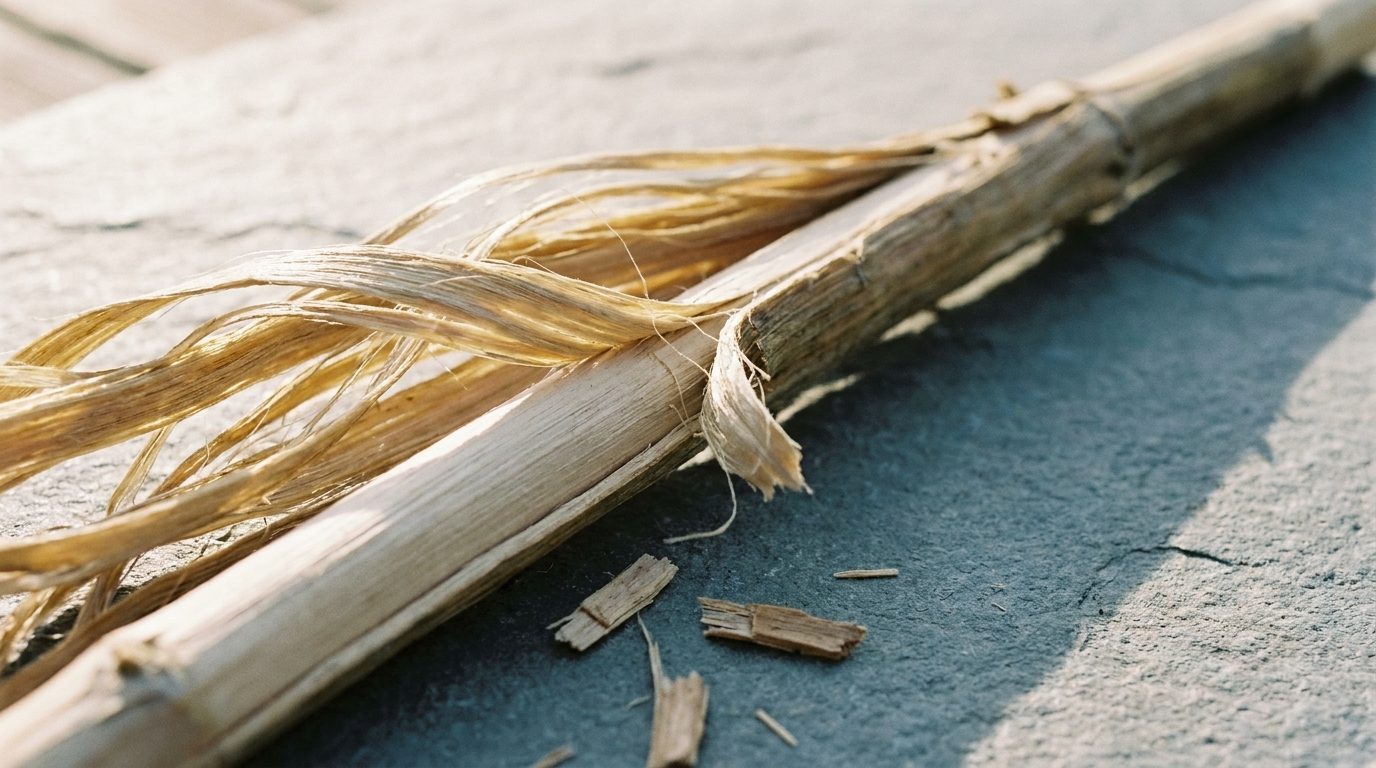
Hemp's reputation for strength rests on one piece of plant anatomy: a ring of long, thick-walled fibre bundles wrapped around a woody core. That structure explains both why hemp outperforms most natural fibres and why a badly processed hemp yarn can still disappoint.
What is actually inside a hemp stalk?
Cut a mature fibre hemp stalk in cross-section and you find concentric zones. A thin outer skin covers the bast layer, where bundles of long fibre cells run more or less the full height of the plant, cemented to one another by pectins, waxes and hemicelluloses. Inside the bast sits the hurd, or shiv, a woody lignin-rich core that snaps like balsa. At the centre of a well-grown stalk there is a hollow pith.
The woody core is the bulk of the stalk by weight; bast is the minority fraction. Practically the whole of hemp's tensile reputation belongs to that minority. When someone says hemp is stronger than cotton, they are comparing cotton lint to hemp bast, not to the stalk as a whole, and certainly not to the hurd.
Why cellulose content and fibre geometry both matter
Hemp bast cells are extraordinarily long compared with the seed hairs that make cotton. Individual fibre cells are measured in centimetres rather than millimetres, and the technical bundles they form can run metres before they are cut. Their walls are dominated by cellulose, with much less lignin than the woody core sitting immediately inside them.
Geometry matters as much as chemistry. Cellulose is laid down in the cell wall as microfibrils that spiral around the axis of the cell. In bast fibres that spiral is shallow, so the microfibrils sit close to parallel with the length of the fibre. A pull along the fibre then loads the cellulose chains along their strongest direction instead of trying to unwind a steep helix. Wood fibres, with steeper spirals, stretch more and stiffen less.
The result is a natural composite: stiff, largely crystalline cellulose reinforcement held in a softer matrix of hemicellulose and pectin. Hemp bast is therefore strong and stiff with low elongation. It does not stretch far before it breaks, which is exactly why hemp cloth feels crisp, takes a sharp crease, and resists bagging at knees and elbows.
Does hemp really get stronger when wet?
Like flax, hemp behaves unusually in water. Most fibres lose tensile strength when saturated; cellulosic bast fibres generally hold their strength or gain slightly, because water swells the matrix and allows load to redistribute between fibrils rather than concentrating at a single flaw. That behaviour is why hemp and flax dominated sailcloth, cordage, netting and fire hose for centuries, long before anyone had measured a microfibril angle.
The caveat is biological rather than mechanical. Wet hemp left wet feeds the same mould and rot organisms that break down pectin and cellulose during retting. Wet strength is a property of the fibre, not a licence to store it damp.
Where does all that strength get lost?
A strong fibre and a strong yarn are different achievements, and most of hemp's potential is won or lost between the field and the spinning frame.
- Retting. Under-retted straw keeps its bundles glued together and mills badly. Over-retted straw has had its cellulose attacked by the same microbes that were meant to eat only the pectin. Both cost strength, and only one of them is obvious by eye.
- Decortication. Aggressive hammer milling breaks fibre along with hurd. Shorter fibre means more twist and more fibre ends per length of yarn, and ends are where yarns fail.
- Cottonisation. Splitting technical bundles into short elementary fibres so they will run on cotton machinery is a deliberate trade of length for spinnability.
- Blending. A yarn with a modest hemp percentage behaves mostly like whatever makes up the rest of it, no matter what the hangtag emphasises.
What actually damages hemp in service?
Hemp's vulnerabilities are chemical and abrasive rather than tensile. Strong acids hydrolyse cellulose, so acidic stain treatments and long vinegar soaks are worth avoiding. Chlorine bleach degrades the fibre and yellows it over time. Prolonged unshaded ultraviolet exposure slowly embrittles any cellulose fibre, which is why outdoor hemp canvas benefits from a protective finish or a sheltered life.
Because hemp has low elongation, repeated sharp folding in the same place fatigues it faster than general wear does. A collar edge, a garment stored on the same crease for years, or a rope always bent over the same fitting will fail before the surrounding material shows anything at all. Rotate creases, wash grit out of the weave, and hemp goods routinely outlast the thread they were sewn with.
Where the strength is worth paying for
Strength per gram matters most where a product fails by tearing, abrading or stretching out of shape: workwear and aprons, bags and webbing, canvas and awnings, cordage, upholstery, geotextiles, and fibre reinforcement in moulded composites. It matters least in soft, drapey, next-to-skin knitwear, where the fibre has usually been cottonised and blended anyway and you are buying comfort rather than tensile performance. Before you pay a premium for hemp content, decide which failure mode you are actually trying to prevent. If the answer is tearing, abrasion or sag, the fibre's headline property is doing real work; if the answer is comfort, judge the fabric on its hand and construction instead. The rest of our coverage, from field to finished cloth, is in the article index.